
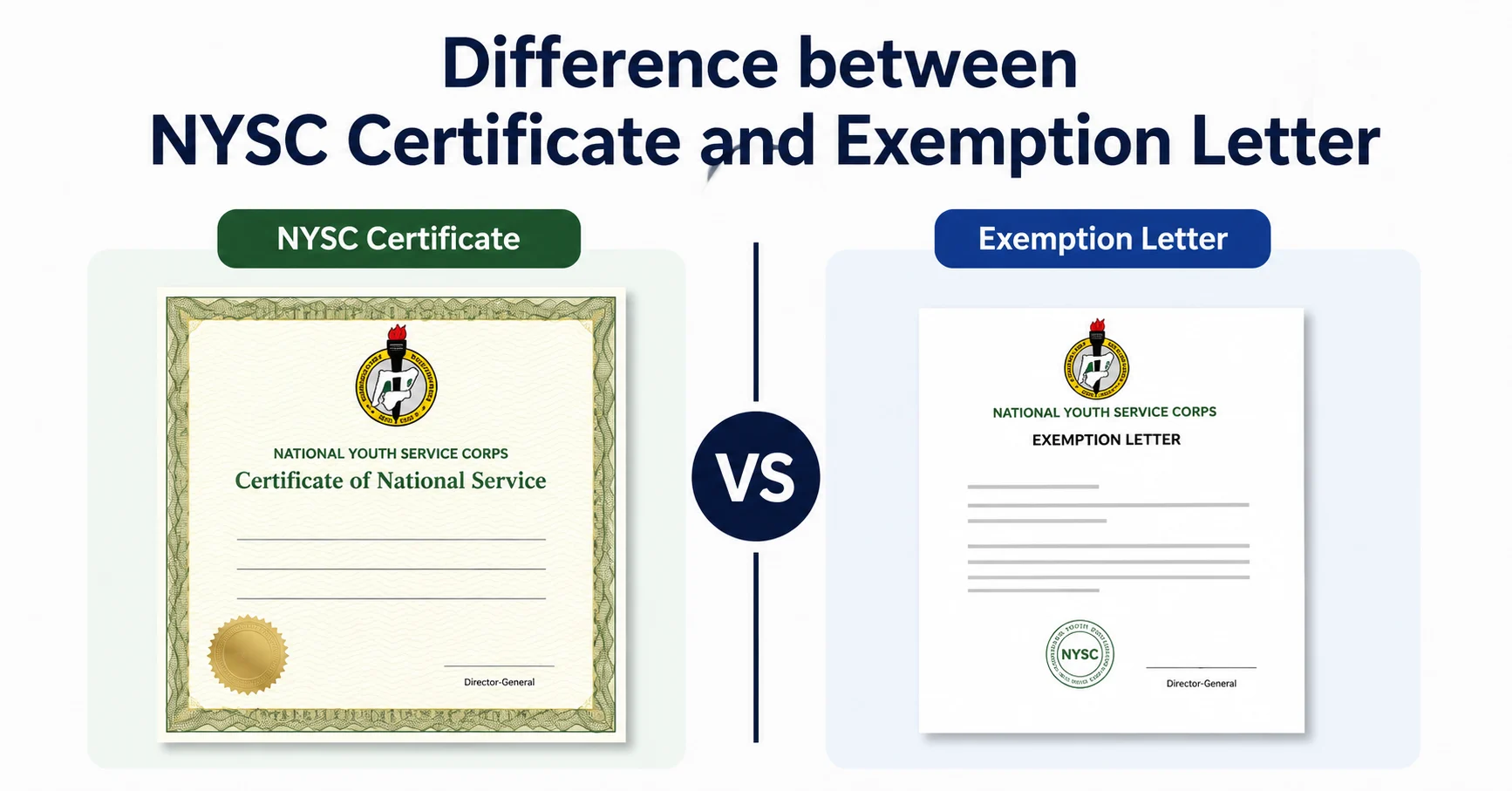
You’ve completed your year of service. You’ve submitted all required documents, attended clearance meetings, and now you’re wondering: will you receive an NYSC certificate or an exemption letter? Understanding the difference between these two documents could save you from costly mistakes during job applications, professional licensing processes, and even international travel. Many Nigerians don’t realize these documents serve completely different purposes until they’re asked to produce the wrong one at a critical moment.
Both documents come from the National Youth Service Corps (NYSC), and both are official government papers. Yet they represent entirely different participation statuses in Nigeria’s mandatory youth service program. One confirms you completed the full one-year program, while the other exempts you from service altogether based on specific criteria. Mixing them up or presenting the wrong document when applying for jobs, contracts, or professional certifications can delay your progress by months.
This article breaks down everything you need to know about difference between NYSC certificate and exemption letter, including when you receive each one, what they look like, how they differ legally, and which situations require which document. Whether you’re a recent graduate, someone who qualified for exemption, or an employer trying to verify credentials, you’ll find clear answers backed by official NYSC regulations.
What Is an NYSC Discharge Certificate?
An NYSC discharge certificate is the official document issued to corps members who successfully complete the mandatory one-year national service program. This certificate serves as proof that you participated in and finished all three phases of the NYSC scheme: orientation, primary assignment, and winding-up activities.
The certificate contains your personal details, service number, call-up number, state of deployment, year of service, and the discharge date. It features the NYSC logo, an official serial number, and signatures from authorized NYSC officials. The document comes printed on security paper with watermarks to prevent forgery.
Who Receives an NYSC Certificate?
You qualify for an NYSC discharge certificate if you meet these conditions:
- Completed a minimum qualifying degree program before turning 30 years old
- Successfully participated in the three-week orientation camp
- Served at your place of primary assignment for the required duration (typically 11 months)
- Attended Community Development Service (CDS) activities regularly
- Maintained acceptable conduct throughout the service year
- Submitted all required clearance documents before the passing-out parade
The discharge certificate typically is given immediately after your passing-out parade. if there is any issues with the discharge certificate, during this waiting period, you can collect a discharge clearance document (also called Form 7 or testimonial) from your state NYSC secretariat. This temporary document helps you apply for jobs while waiting for the official certificate.
Types of NYSC Discharge Status
Your NYSC certificate reflects one of several discharge statuses based on your performance during service:
Certificate of National Service: Issued to corps members who completed the full service year with satisfactory conduct and participation. This is the standard certificate most people receive.
Certificate of Exemption from National Service: Despite the confusing name, this differs from the exemption letter discussed later. This certificate goes to corps members who started service but couldn’t complete it due to specific circumstances like medical conditions or permanent disability acquired during service.
Certificate with Remarks: Given to corps members who completed service but displayed conduct issues during the year. The remarks section notes the behavioral problems, which could affect future opportunities requiring NYSC documentation.
What Is an NYSC Exemption Letter?
An NYSC exemption letter is an official document that releases certain individuals from participating in the one-year national service program. Unlike the certificate, which confirms completion, the exemption letter confirms you weren’t required to serve at all based on age, prior service, health conditions, or other qualifying circumstances.
This letter acknowledges that while you fall under categories normally obligated to serve, specific factors exempted you from this requirement. The document contains your personal information, the reason for exemption, and official stamps from the NYSC headquarters or state directorate.
Who Qualifies for NYSC Exemption?
The NYSC Act outlines specific categories of people eligible for exemption:
- Age: Graduates who are 30 years or older at the time of graduation from university or completing their NYSC call-up procedures
- Prior Service: Individuals who already completed NYSC with a previous qualification
- Medical Reasons: People with permanent physical disabilities or serious health conditions that make service participation impossible
- National Honors: Recipients of national honors awards (though this category rarely applies)
- Military Service: Those who served in the Nigerian Armed Forces for a minimum period
- Professional Qualifications: Certain professional qualifications obtained abroad before age 30 (with proper assessment)
Getting an exemption letter requires submitting documentation proving you meet one of these criteria. For age exemptions, you’ll need your birth certificate, age declaration affidavit, and graduation documents. Medical exemptions require reports from government-recognized medical institutions confirming your condition’s permanent nature.
How to Apply for an NYSC Exemption Letter
The application process differs from regular NYSC mobilization. Here’s what you need to do:
First, visit the NYSC state directorate in your state of residence or origin. Bring original copies of all supporting documents: degree certificate, birth certificate or age declaration, and any additional papers specific to your exemption category.
Complete the exemption application form at the secretariat. The form asks for personal details, educational background, and reasons for seeking exemption. Attach passport photographs as specified in the requirements.
Submit your application along with processing fees. The NYSC office will review your documents, verify their authenticity, and assess whether you meet exemption criteria. This review process takes between three weeks to three months, depending on the state and workload.
Once approved, you’ll receive a notification to collect your exemption letter. Some states now offer online tracking systems where you can monitor your application status using a reference number.
Major Difference Between NYSC Certificate and Exemption Letter
While both documents come from NYSC, they differ significantly in meaning, appearance, and application. Understanding these differences prevents confusion when dealing with employers, licensing boards, or international institutions.
Legal Recognition and Status
An NYSC certificate proves you fulfilled your constitutional obligation under Section 315 of the 1999 Constitution and the NYSC Act. It shows you actively participated in nation-building through community service and skill development programs for one year.
An exemption letter confirms you’re legally excused from this obligation. You haven’t participated in the service year, but you’re not in violation of the law because you meet specific exemption criteria. Both documents carry equal weight legally, neither is “better” than the other.
Physical Appearance and Security Features
The NYSC certificate comes as a full-sized document (typically A4) printed on special security paper. It features the Nigerian coat of arms, NYSC logo, multiple official signatures, and a unique serial number. The paper includes watermarks visible when held against light.
Exemption letters typically arrive on official NYSC letterhead paper. While they contain stamps and signatures, they don’t have the same elaborate security features as certificates. The letter format resembles official correspondence more than a formal certificate.
Information Contained
Your NYSC certificate displays comprehensive service details: your corps number, call-up number, state and local government of deployment, name of primary place of assignment, duration of service (from and to dates), and your batch year. It also includes your discipline (course of study) and institution attended.
The exemption letter contains your personal details, qualification details, and most importantly, the specific reason for exemption. It explicitly states the category under which you were exempted (age, medical condition, prior service, etc.) and the legal provision supporting this exemption.
Processing Time and Collection
NYSC certificates typically is given after your passing-out parade. You must collect the certificate in person or authorize someone with a properly documented letter of authorization.
Exemption letters usually are between three weeks to three months from application submission. Since they don’t require centralized batch printing, state directorates can issue them once they verify your eligibility. The faster processing reflects the simpler documentation compared to certificates tracking a full year of service records.
When Do You Need an NYSC Certificate OR Exemption Letter?
Different situations require specific NYSC documentation. Presenting the wrong document can create unnecessary complications, delays, or even disqualification from opportunities.
Job Applications in Nigeria
Most Nigerian employers require NYSC documentation as part of their recruitment process. If you completed the service year, submit your NYSC certificate or discharge clearance document (if your certificate hasn’t arrived yet). If you were exempted, provide your exemption letter.
Some employers specifically state “NYSC certificate holders only” in job advertisements. This phrasing usually indicates they prefer candidates who completed service, though legally, they must accept exemption letters as valid documentation. Organizations cannot discriminate against qualified candidates who have valid exemptions.
For federal government jobs, both documents work equally well. Civil service commission rules recognize exemption letters as equivalent to discharge certificates for employment purposes. State and local government positions follow similar policies.
Professional Licensing and Certification
Professional regulatory bodies in Nigeria, like the Nigerian Bar Association, Medical and Dental Council, Council for Regulation of Engineering, and others, require NYSC documentation before granting practice licenses.
You can submit either your certificate or exemption letter depending on which applies to you. The regulatory bodies verify the document’s authenticity directly with NYSC before processing your license. Make sure your exemption letter clearly states your profession-related qualification if you’re using it for professional registration.
Further Education and Scholarship Applications
Nigerian postgraduate programs typically require NYSC documentation during admission processing. Submit whichever document applies to your situation. Universities accept both as proof you’ve fulfilled national service requirements or been legitimately exempted.
International scholarship applications sometimes request NYSC documentation as part of credential verification. If you completed service, submit your certificate. If exempted, include your exemption letter along with a brief explanation of Nigeria’s youth service system, since foreign institutions might not understand these documents.
Some international universities and scholarship committees request both documents translated or accompanied by explanatory letters. Contact your school’s international office or the scholarship provider beforehand to clarify their specific requirements for Nigerian applicants.
Common Misconceptions About NYSC Certificates and Exemptions
Several myths surround these documents, creating unnecessary worry or confusion. Let’s address the most common misconceptions.
Myth: Exemption Letters Are Less Valuable Than Certificates
This belief has no legal basis. Both documents serve the same fundamental purpose, proving you’ve either completed or been legitimately excused from national service. No law or regulation treats exemption letters as inferior to certificates.
Some people assume employers prefer certificate holders because they completed the full service year. While individual employers might have preferences, legally recognized exemptions cannot be grounds for discrimination. If you meet the job requirements and have a valid exemption letter, you’re qualified.
Myth: You Can Choose Between Getting a Certificate or Exemption
You don’t get to choose which document you receive. Your age at graduation and your service participation determine this automatically. If you graduated before turning 30, you’re expected to serve and will receive a certificate upon completion. If you graduated at 30 or older, or meet other exemption criteria, you qualify for an exemption letter instead.
Attempting to manipulate the system by falsifying age documents or other credentials constitutes fraud. NYSC maintains verification systems to detect document forgery, and penalties include prosecution and permanent blacklisting.
Myth: Lost Certificates Cannot Be Replaced
You can request a replacement certificate if yours is lost, stolen, or damaged. The process involves visiting the NYSC state directorate where you served, reporting the loss, and paying a replacement fee. You’ll need to provide an affidavit sworn at a court, police report of the loss, and photocopies of your original certificate (if available).
The replacement process takes several weeks to months because NYSC must verify your service records before issuing a new certificate. During this period, request a confirmation letter stating your certificate is being replaced, this document helps explain the absence of your original certificate if needed urgently.
Myth: Age Exemption Automatically Happens Without Application
Meeting exemption criteria doesn’t automatically generate an exemption letter. You must actively apply for it through the proper channels. Even if you’re over 30 at graduation, you need to visit the NYSC secretariat, submit required documents, and formally request your exemption letter.
Some graduates mistakenly assume they’re “automatically exempted” and don’t need documentation. This causes problems later when employers or professional bodies request official proof. Always secure your exemption letter even if you’re certain you qualify.
How to Verify Authentic NYSC Certificates and Exemption Letters
Document fraud remains a serious issue in Nigeria. Employers, licensing bodies, and other organizations need methods to distinguish genuine NYSC documents from counterfeits.
Physical Verification Methods
Genuine NYSC certificates contain several security features. Check for watermarks visible when held against light. The paper should feel different from regular printer paper, it’s thicker with a distinct texture. Look for the holographic seal that changes appearance when tilted at different angles.
Examine the printing quality carefully. Original certificates have sharp, clear text without blurriness or uneven ink distribution. The NYSC logo and Nigerian coat of arms should be detailed and properly colored. Photocopies or scanned versions won’t show these features clearly, so request originals during formal verification.
Exemption letters, being regular letterhead documents, are easier to forge. Focus on verifying the signatures, official stamps, and letter reference numbers. Compare these against known authentic samples if possible.
Official NYSC Verification Channels
The most reliable verification method involves contacting NYSC directly. Visit the NYSC online verification portal (when available) and input the certificate serial number or exemption letter reference number. The system confirms whether the document exists in NYSC records.
Alternatively, send verification requests to the NYSC state directorate where the person served or obtained exemption. Provide the individual’s full name, service number (for certificates) or application reference (for exemptions), and year of service or exemption. NYSC typically responds within two weeks for formal verification requests.
For urgent verifications, visit the NYSC office in person. Bring the document and a formal letter explaining why you need verification. Some offices offer same-day verification services for official organizational requests.
Red Flags Indicating Fake Documents
Be suspicious if the certificate or letter contains these warning signs:
- Spelling errors in official text or the NYSC name
- Incorrect NYSC logo design or colors
- Service numbers that don’t match the established format for that year
- States of deployment that don’t exist or incorrect state names
- Unusual paper quality too thin, wrong color, or regular printer paper
- Missing or poorly executed security features
- Signatures that look identical across multiple certificates (suggesting stamp use rather than actual signatures)
If you discover a fake certificate or exemption letter during employee verification or application review, report it immediately to NYSC through their official channels. Provide copies of the fraudulent document and any information about where it originated.
Frequently Questioned Topics About NYSC Documentation
Can You Do NYSC After Age 30 If You Want To?
No, NYSC policy doesn’t allow voluntary participation once you exceed the age limit. The age 30 cutoff is strict, if you’re above this age at graduation or mobilization, you must apply for exemption rather than serving.
Some people want to serve despite being overage, thinking it might benefit their career prospects or because they value the experience. Current regulations don’t provide this option. You’ll receive an exemption letter based on your age, and that’s your final documentation.
Does Exemption Affect Your Career Prospects?
Legally, no. Exemption letters carry the same weight as certificates for employment, licensing, and other official purposes. Any organization discriminating against exempted individuals based solely on having an exemption letter rather than a certificate would be acting outside established regulations.
That said, individual employers might have unofficial preferences. Some organizations particularly value the network-building and experience gained during service year. However, if you’re qualified for a position and have valid exemption documentation, you meet the legal requirements for consideration.
What Happens If You Lose Both Your Certificate and Clearance Document?
Start the replacement process immediately by visiting the NYSC state directorate where you served. You’ll need to obtain an affidavit from a court declaring the loss, get a police report, and submit a formal application for certificate replacement.
In the meantime, request a confirmation letter from the state office verifying you completed service and are in the process of obtaining a replacement certificate. This letter provides temporary proof while you wait for the replacement, which can take several months.
Keep digital copies (scanned and photographed) of all important documents in cloud storage to prevent total loss in the future. While these copies can’t replace originals for official submission, they help during the replacement application process and provide reference information.
Can Exemption Letters Be Used for International Purposes?
Yes, exemption letters work for international applications just like certificates do. However, foreign institutions might not understand Nigeria’s NYSC system, so include a brief explanation when submitting your exemption letter.
Some applicants draft one-page explanatory notes describing the NYSC program, explaining who qualifies for exemption, and clarifying that exemption letters are legally equivalent to completion certificates. This proactive explanation prevents confusion and speeds up application processing.
For credential evaluation services (like WES for Canadian immigration), submit your exemption letter along with your academic transcripts and degree certificate. These services are familiar with Nigerian documentation and process exemption letters routinely.
Conclusion
Whether you’re expecting an NYSC certificate or need to apply for an exemption letter, taking prompt action ensures you have the documentation you need when opportunities arise. Don’t wait until a job offer or application deadline forces you to scramble for these documents.
If you’ve completed your service year, follow up regularly with your state NYSC office about your certificate status. Collect your discharge clearance document immediately after passing out, as this serves as temporary proof while waiting for your certificate. Keep this document safe, replace it immediately if lost, since it might take months before your certificate arrives.
If you qualify for exemption, start the application process as soon as possible after graduation. Gather all required supporting documents. Such as birth certificate, age declaration, degree certificate and any category-specific papers. Visit your state NYSC directorate to begin the application rather than assuming exemption happens automatically.
Regardless of which document you have, store multiple copies in different safe locations. Scan high-quality color copies and save them to cloud storage. Keep at least one certified true copy for use during applications while protecting your original document. These precautions save time and stress if you ever need to replace lost documents or submit copies for various applications.
Most importantly, verify that any NYSC document you receive is accurate. Check all personal details, dates, and other information immediately upon collection. Correcting errors becomes much harder once you’ve left the NYSC office with an incorrectly prepared document. Take time to review everything carefully before leaving the secretariat.
Your NYSC certificate or exemption letter represents more than just another piece of paper, it’s official documentation of your relationship with a constitutional requirement that affects many aspects of professional life in Nigeria. Treat these documents with the same care you give your degree certificate and other important credentials. Protect them, keep them accessible, and know when each document is needed to avoid unnecessary complications in your career journey.